Offshore wind is likely coming. But what should it look like?
Across Europe, interest in developing offshore wind is growing rapidly, driven by the need to decarbonise our energy systems and reduce dependence on fossil fuels. Finland is no exception. With a target of carbon neutrality by 2035, wind power is expected to play an increasingly important role in the country's energy system, and interest in developing offshore wind is growing quickly.
At first glance, the logic seems fairly straightforward: we need to decarbonise, offshore wind produces renewable electricity, so we should build more offshore wind. However, the more I have worked on offshore wind, the less straightforward that equation seems. The sea is not an empty space waiting for turbines. It is already home to ecosystems, fisheries, shipping routes, recreational activities, defence interests and coastal communities. Offshore wind can create jobs and regional economic opportunities, but it can also create environmental and social impacts.
This raises a question that I think is increasingly important as we move from discussing the potential of offshore wind to actually planning its development: what kind of offshore wind future would we actually want?
That was the starting point for our latest research. Rather than asking simply how much offshore wind Finland could develop, we wanted to explore what a desirable future for the industry might look like, and what would need to happen to get there.
Looking beyond the immediate project
Much of the discussion around offshore wind understandably focuses on individual projects. Where should a wind farm be located? How much will it cost? Can it connect to the grid? What are its environmental impacts? Will people accept it?
These are all important questions, but they are also relatively immediate ones. We were interested in taking a step back and thinking about the longer-term future of the industry as a whole.
Rather than trying to predict what offshore wind development in Finland might look like based on today's trends, we asked stakeholders to imagine a desirable future in 2035. We then worked backwards from that future to identify what would need to happen between now and then to make it possible.
This is where visioning and backcasting came in. In February 2023, we brought together experts from different parts of the Finnish offshore wind landscape for two futures workshops, followed by seven interviews. Participants included representatives from the wind industry, government and public administration, regional politics, research, conservation and other marine interests. We deliberately encouraged participants to think about alternative and potentially conflicting futures, rather than assuming that offshore wind development was necessarily desirable or inevitable.
What I found particularly interesting was the degree of convergence that emerged. There were certainly differences in emphasis and priorities, but participants repeatedly returned to a surprisingly consistent set of ideas about what would need to be true for offshore wind to become a desirable part of Finland's future energy system.
Offshore wind — but not at any cost
The resulting vision was not a vision of unlimited offshore wind development. Instead, offshore wind was seen as having an important potential role in Finland's future energy mix and climate efforts provided that certain conditions are met.
That distinction is important. The vision we developed was essentially a conditional one: offshore wind could contribute to climate and energy goals, but only if its environmental and social impacts were properly understood and addressed, suitable locations were identified, other marine uses were taken into account, and the benefits of development extended beyond simply producing electricity.
In other words, offshore wind was not treated as an inevitable solution. This is, for me, one of the most important messages from the research.
Renewable energy is essential for tackling climate change, but renewable does not automatically mean sustainable. This is what is sometimes described as a “green–green dilemma”: the conflicting situation where two environmental objectives come into tension with each other. We need clean energy to address climate change, while at the same time a need to protect biodiversity and functioning ecosystems. Offshore wind sits directly in the middle of that tension.
The vision developed through our workshops captured this quite well. Participants saw offshore wind as something that could make an important contribution to Finland's energy mix and climate objectives, but only alongside strong biodiversity protection, consideration of other marine uses, and expectations that development should create meaningful regional and societal benefits.
Five conditions for a desirable future
When we analysed the discussions, five broad preconditions emerged. Together, they provide a useful way of thinking about what a sustainable offshore wind future might require.
First, environmental impacts need to be understood and managed. Biodiversity protection emerged as a particularly strong boundary condition. Participants did not see environmental assessment as something that should simply happen at the end of the development process. Instead, environmental considerations need to help determine where and how development happens in the first place. This also means considering cumulative impacts and interactions with other marine uses, rather than looking at each project in isolation.
Second, we need the skills to make it happen. This was perhaps less obvious than some of the other findings, but participants repeatedly highlighted the importance of people and expertise. Developing offshore wind in Finland requires knowledge in engineering, marine ecology, spatial planning, stakeholder engagement and many other areas, while the Finnish marine environment presents particular technical challenges, including cold and icy conditions. If we want offshore wind to develop sustainably, we therefore need to invest in education, research and skills alongside the physical infrastructure.
Third, governance needs to be clear and predictable. Offshore wind development involves multiple authorities, levels of government and regulatory frameworks, and the distinction between territorial waters and the Exclusive Economic Zone has historically added complexity in Finland. For developers, uncertainty creates risk; for authorities, it makes long-term planning and coordination more difficult; and for society, unclear decision-making processes can undermine trust. A sustainable offshore wind future therefore requires more than ambitious targets. It also requires stable, transparent and predictable rules for how development actually happens.
Fourth, the benefits need to reach regions and communities. Offshore wind has the potential to generate economic opportunities well beyond electricity generation itself, through manufacturing, ports, logistics, vessels, maintenance, decommissioning and other parts of the wider value chain. This matters because offshore wind projects are built in particular places, and those places experience both the benefits and the impacts. Participants therefore saw regional participation in the value chain as an important part of making development socially legitimate.
Finally, offshore wind needs to be treated as part of the energy system, rather than as the whole solution. Its role needs to be considered alongside other energy technologies, grid capacity, energy security and flexibility. A sustainable energy system is not necessarily one that maximises any single technology; instead, it needs to balance different technologies and objectives within the system as a whole.
From vision to action
Of course, imagining a desirable future is the easier part. The more difficult question is how we actually get there.
Our workshops therefore did not stop at developing the vision. We asked participants to work backwards and identify the processes and actions that would be needed to make that future possible. Five broad areas emerged: investment in education and training; clearer and more predictable regulation; continued technological innovation and infrastructure investment; development of private-sector businesses and value chains; and coordinated planning of ports, grids and other infrastructure. The figure below highlights the processes and pre-conditions.
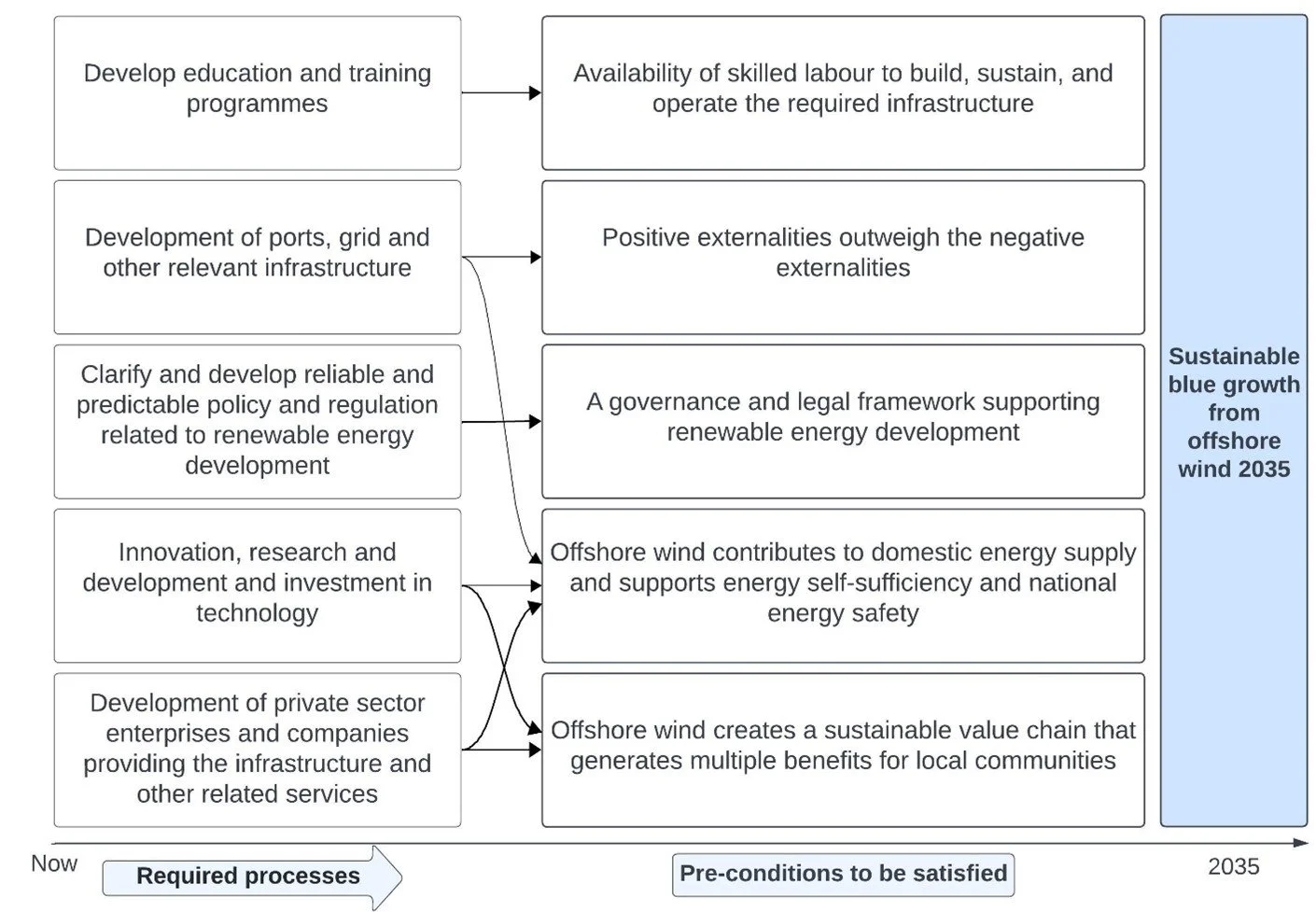
Figure 1: the required processes and pre-conditions needed for a sustainable future of offshore wind.
These are all highly interconnected. You cannot simply solve the “offshore wind problem” by building turbines. You need the grid to connect them, ports and vessels to service them, people with the right skills, regulation that gives investors confidence, marine spatial planning that accounts for biodiversity and other users, and a value chain that allows coastal regions to benefit from the transition.
This is why I increasingly see offshore wind as being as much a governance and planning challenge as a technological one. The technology itself is obviously important, but whether offshore wind becomes a sustainable part of the energy transition depends on the institutions, infrastructure, knowledge and processes that surround it.
What surprised me most
Perhaps the most interesting finding for me was not any individual condition, but the fact that a relatively coherent vision emerged at all.
We deliberately brought together people with different professional backgrounds and encouraged them to think about competing and even conflicting futures. Yet rather than simply producing a list of opposing positions, the process created space to identify areas of common ground.
That is one of the things I find particularly valuable about participatory futures research. It does not necessarily make disagreement disappear, nor does it magically create consensus. Instead, it gives people an opportunity to make their assumptions explicit and explore what they actually mean when they talk about a “sustainable” future.
Sometimes, that reveals that people who appear to disagree about the future actually agree on quite a lot; they simply approach the problem from different starting points. In our case, participants with quite different roles and interests were able to identify a set of conditions under which offshore wind could be considered desirable, legitimate and sustainable.
But whose vision is it?
There is, however, an important caveat to this research. The vision we developed is an expert vision, not a national consensus.
Our participants were knowledgeable professionals, but they cannot represent everyone who might be affected by offshore wind development. People living in coastal communities, fishers, recreational users and others with direct connections to marine space may have different priorities and concerns. The paper therefore explicitly recognises that wider public and local engagement is an important next step.
This is also where I think the research leaves us with a particularly interesting question. What happens when we take this vision beyond the expert community? Would local communities develop the same vision? Would they challenge some of its assumptions? Would different ideas about biodiversity, regional benefits or the use of marine space emerge?
I suspect that they would, at least to some extent, and I don't see that as a problem. It is precisely why participation matters. A shared future should not be something that is decided once by a small group of experts; it needs to be something that can be questioned, challenged and refined as we broaden the conversation.
So, what kind of offshore wind future do we want?
For me, the main takeaway from this research is that the debate needs to move beyond “how much offshore wind?”
That is an important question, but it is not enough. We also need to ask where offshore wind should go, what environmental limits should shape its development, who should benefit, what infrastructure and skills we need, and how decisions should be made. Perhaps most importantly, we need to ask under what conditions we would consider offshore wind to be a genuinely sustainable part of Finland's energy transition.
Our research suggests that there is potential for offshore wind to play an important role in Finland's energy future, but that future is neither automatic nor predetermined. It will depend on choices about governance, biodiversity, infrastructure, skills, regional development and participation.
And perhaps that is the real value of thinking about the future before it arrives. Instead of asking only what future is most likely, we can ask what future is desirable — and what would we need to do differently today to make it possible?
That is the conversation I hope this research contributes to.
The paper: Exploring the prospects for a shared vision of offshore wind energy at the national level, published in Marine Policy (2026), with Maria Malho, Jenni Kilpi and Kari Hyytiäinen. You can read the full article here: https://doi.org/10.1016/j.marpol.2026.107261
The research was conducted as part of the BLUEADAPT project, funded by the Strategic Research Council of the Academy of Finland.
